
For architects
The palapa, resolved like any other roof system.
Geometry, pitch, junction details and test documentation: what it takes to specify synthetic thatch without leaving decisions open to the site.
The real problem
The obstacle is not the aesthetic: it is the documentation.
The image of a palapa sells itself. What stalls the project is the moment the reviewer asks for a fire test, the insurer asks about wind, and the client works out how many times it will need re-thatching over twenty years.
NIPA synthetic thatch answers those three questions with documents rather than sales arguments. This page gathers those documents and the design criteria that go with them.
- Class A ASTM E108
- 260 km/h
- 6,000 h UV ASTM G155
- 20-year warranty
Geometry without penalty
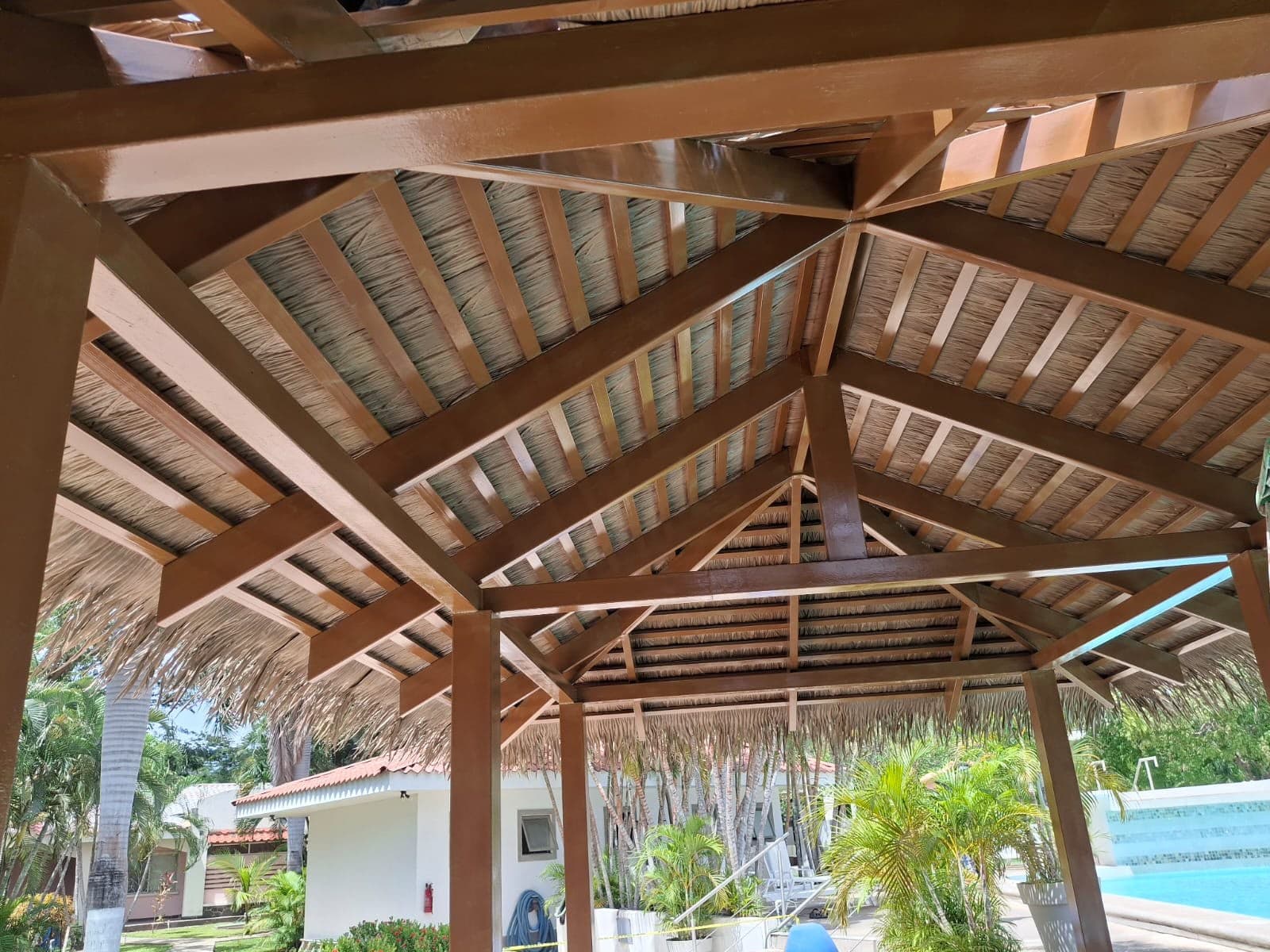
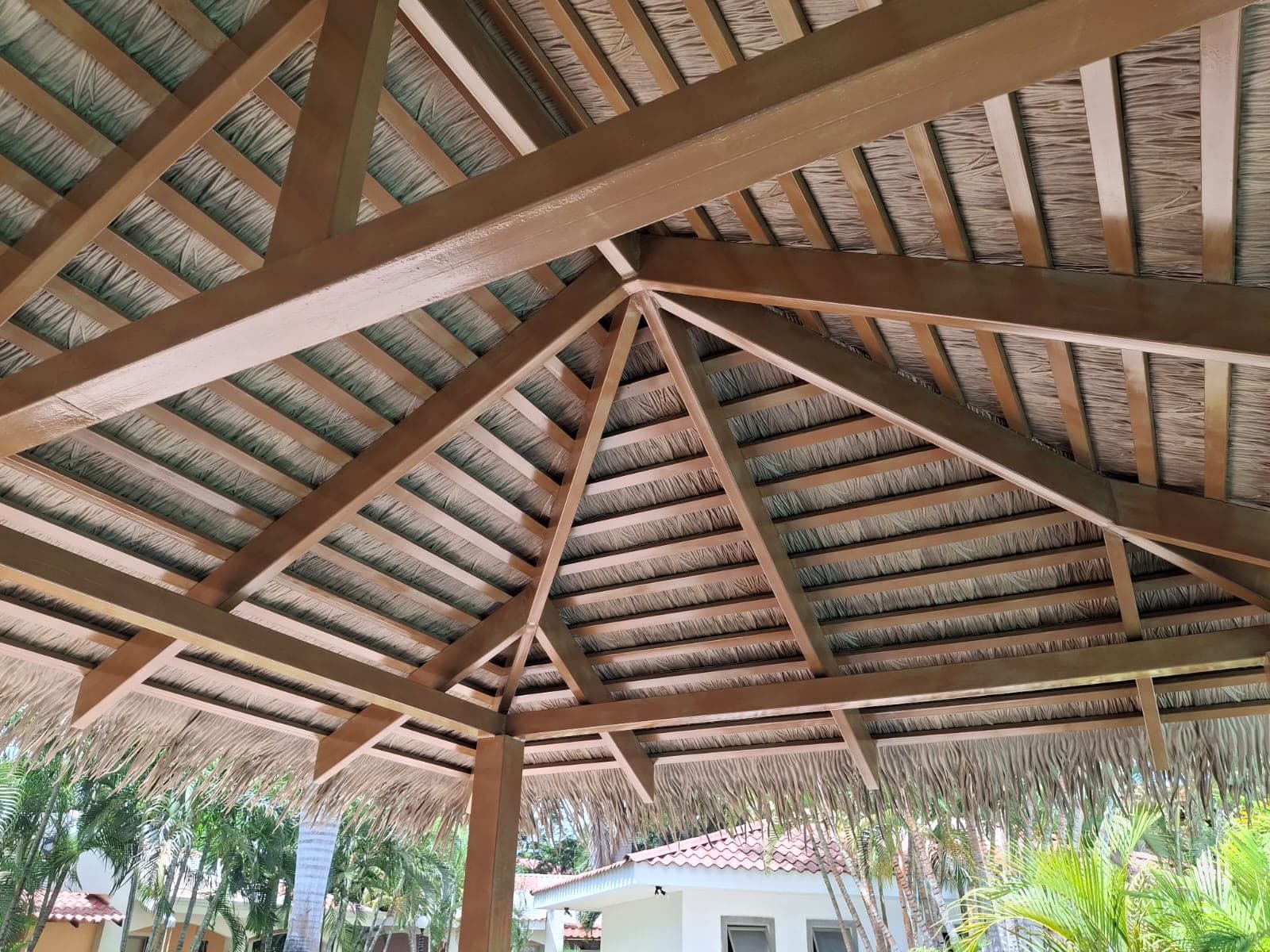
Hips, cones, curved planes and long ridges. The panel is flexible and large-format, so the form is set by the project rather than by the limits of the material.
A repeatable detail
22 cm exposure, 5 cm side lap and seven fixings per panel: a standard detail the crew executes the same way on the first phase and on the last.
Specifiable colour
Tone matched across batches and across phases, with mould mixing that avoids a visible repeating pattern seen from below — which is the angle a palapa is actually read from.
In the drawing set
What goes into the documents.
Roof plan and quantity schedule
On your plan we calculate true sloped area, panels, boxes and pallets with the 10% waste already included, and return the schedule in the format your cost plan uses.
Junction details
Ridge, hip, valley, eave, wall junction and gutter termination. We send the base details in editable format so your team adapts them instead of drawing them from scratch.
Schematic design
Four decisions worth settling early.
None of the four is expensive to resolve in schematic design; all four are expensive to correct once the roof plane is drawn.
01
Pitch and drainage
18° is the minimum. Fixing it at the start avoids reworking sections when the roof has already been drawn at 15° for the sake of the silhouette.
02
Battens and spacing
Batten spacing derives from the 22 cm exposure. Setting it early puts the secondary structure and the timber or steel take-off in order.
03
Overhangs and eaves
The eave decides how much sun and rain the façade takes. With a synthetic roof there is no maintenance penalty for a deep eave, so it is worth using.
04
Junction with hard construction
Terminations against walls, chimneys or slabs are resolved with metal flashing. Defining that material alongside the roof avoids improvising on site at the end of the job.
Frequently asked
What studios ask.
Are construction details available in CAD?
Yes. We send the base ridge, hip, eave and wall-junction details in editable format, along with the panel data sheet.
How does it look at ten years?
The panel is tested to 6,000 hours of UV exposure under ASTM G155, roughly twelve years of intense sun. The warranty covers sudden colour loss; the expected variation is gradual and uniform across the plane, not patchy or zoned.
Can it be combined with another roof system on the same project?
Yes, and it usually is: slab or metal on the main volume and thatch over social areas, ranchos and terraces. The junction between systems is resolved with metal flashing and an independent starter batten.
Does it work for vernacular or heritage-sensitive projects?
That depends on the approving body. Technically the reading at distance is equivalent to natural fibre; on paper the argument in favour is usually fire performance, which a vegetal roof cannot evidence.
Drawing the roof right now?
Send us the plan and we return the take-off, the details and the test documentation.